
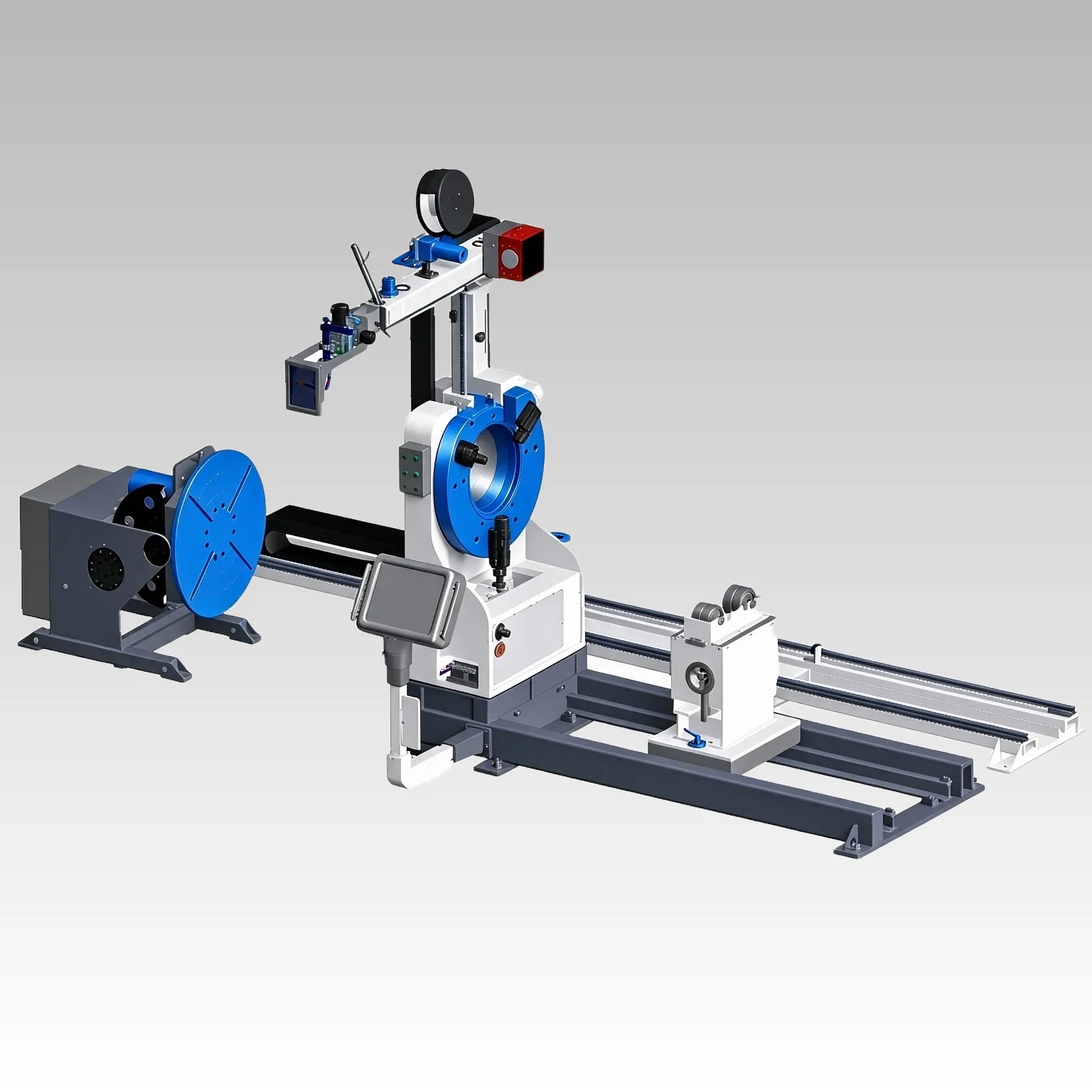
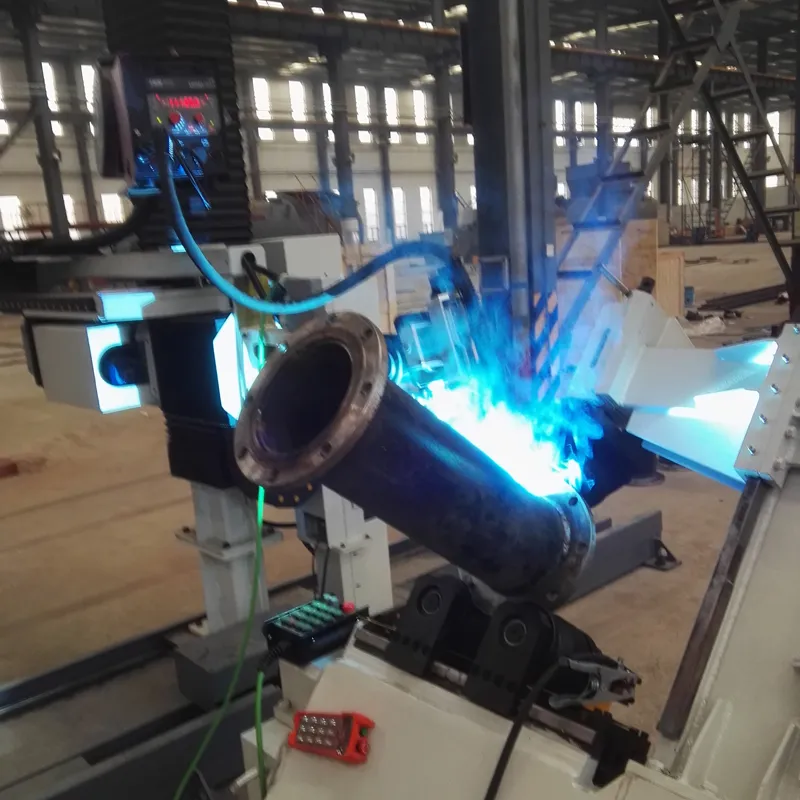
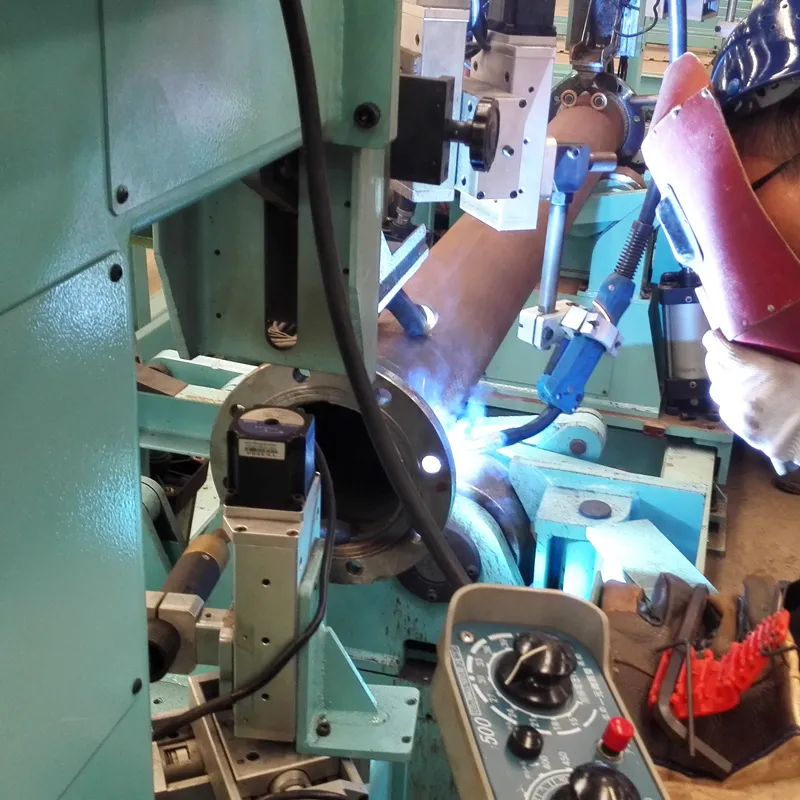
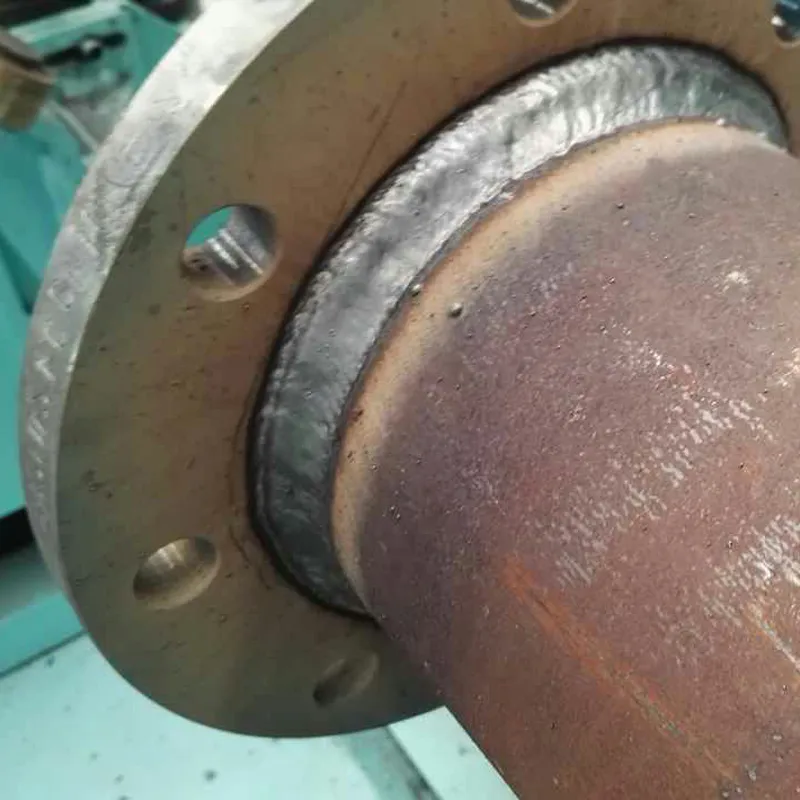
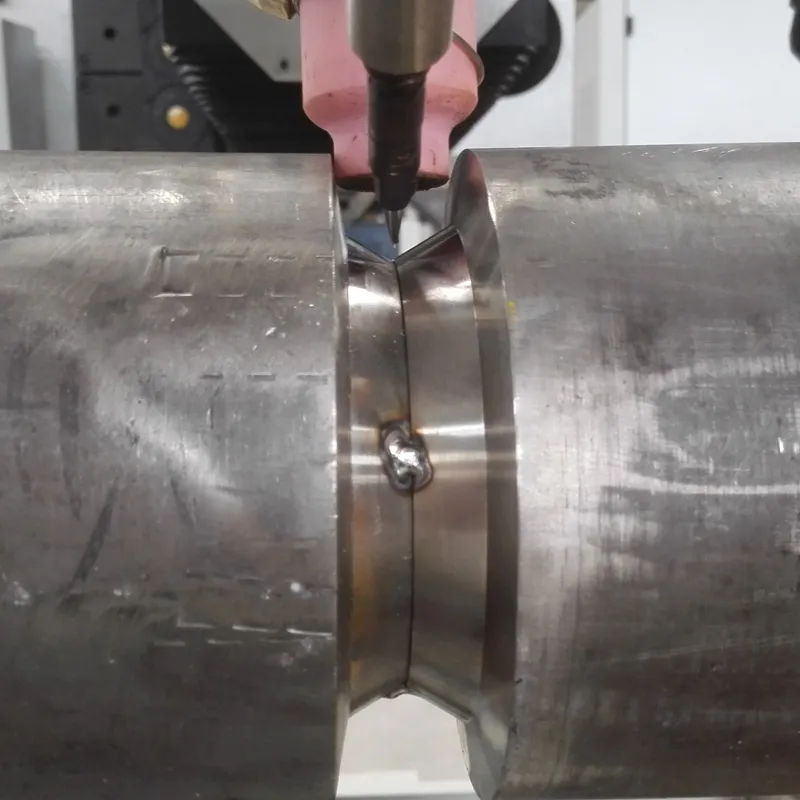
Automatic Pipe and Flanges TIG Welding Station
Tackling pipe-to-flange welding manually often leads to uneven penetration and rework. Our Automatic TIG Welding Station is built to eliminate that inconsistency on your shop floor. By integrating a robust rotating positioner with precise torch manipulation, this machine guarantees uniform weld beads around the entire circumference, whether you are working with carbon steel or stainless. It effectively handles the demanding heat control required for TIG, while delivering the high deposition rates of MIG. If you want to boost your throughput and get flawless, leak-proof joints every single shift, this automated setup is the practical upgrade your fabrication line needs.
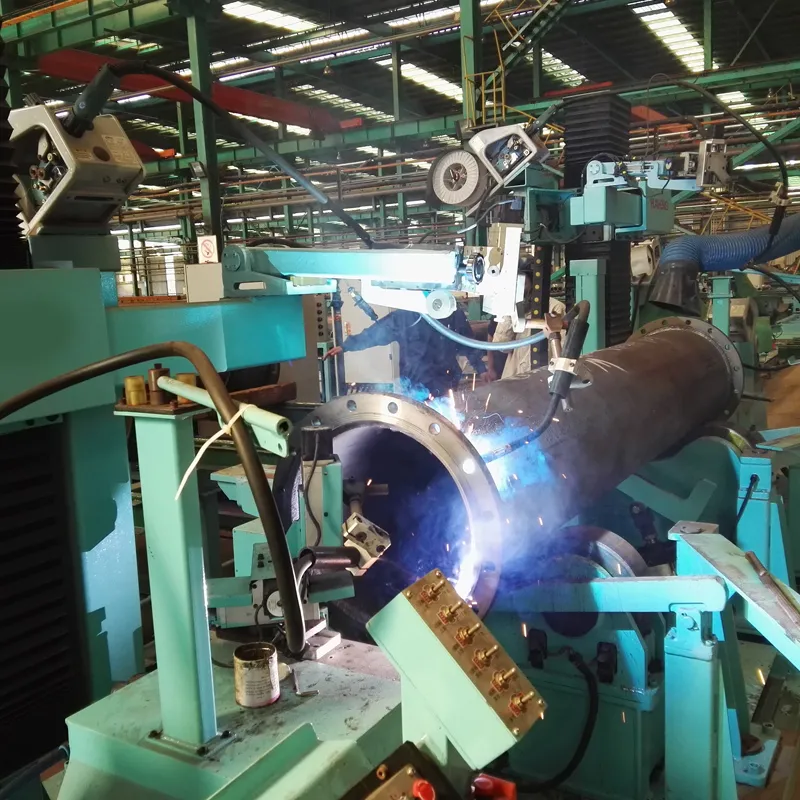
Automatic Pipe and Flanges TIG Welding Station is specially designed for straight pipe/pipe, pipe/fittings (elbow, tee, and reducer), and pipe/weld-neck flange butt joint connection welding. This welding system is with one welding head, with auto-switch TIG welding torches, automatic TIG or hot wire TIG root pass, TIG fill/cap welding for OD1″~12″ pipe, with length 3 or 6mm standard pipe.It is used for butt joint and fillet joint application.
Butt joint: TIG welding for root pass /fill/cap.
Fillet joint: TIG depends on process required by customer.
- To solve axial and radial jumping during rotation
- Convenient for load/unload and clamping
- Stable mechanism design is easy for automatic TIG root pass process
- Long pipe welding application advantage
- Pipe support with manual up & down to fit for different diamete
Products Videos
Lorem ipsum dolor sit amet, consectetur adipiscing elit. Ut elit tellus, luctus nec ullamcorper mattis, pulvinar dapibus leo.
Product Details
Streamline Your Pipe Fabrication with Automated Welding,Consistent, High-Quality Welds for Pipe and Flange Assemblies
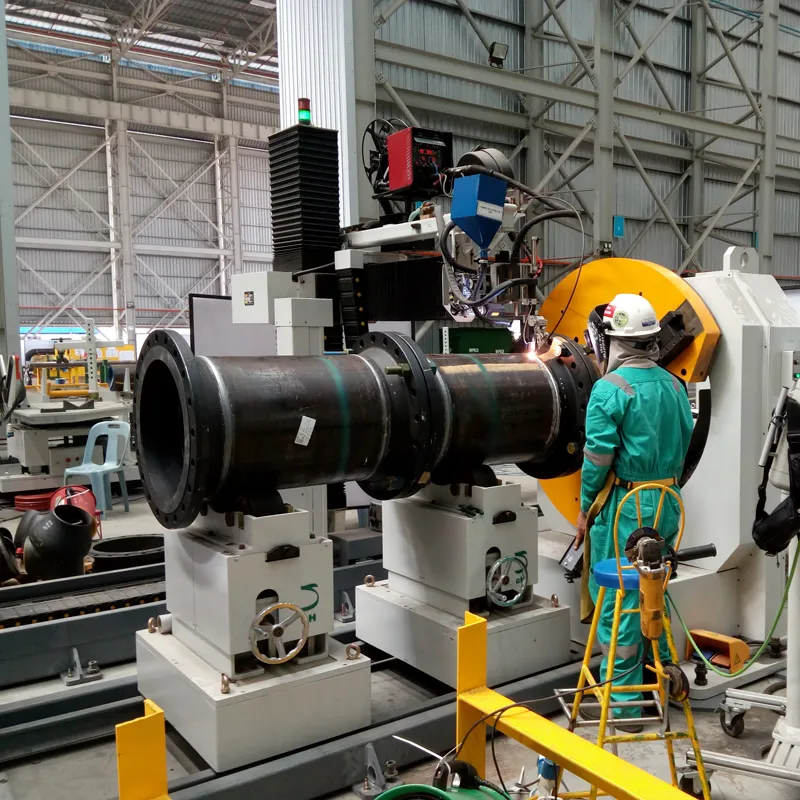
Automatic Pipe and Flange TIG Welding Station
Most pipe spools don’t fail on the fill passes. They fail at the root, where a hand torch is fighting gravity, fit-up tolerance and the clock.
This station takes that fight off the operator’s hands. The pipe or flange is clamped on a rotating positioner and turned under a fixed torch, so the root is always laid in flat position. TIG does the root: low heat, clean penetration, no sugaring on stainless.
A PLC runs the sequence. You call up a WPS by diameter and wall thickness from the stored library, the head locates the joint, oscillation and travel speed follow the program. One operator can load, weld and unload without a coded welder standing over the arc for the whole pass.
We build it for shops welding the same joint families every day: pipe to pipe, pipe to flange, flange to elbow. Different diameters, but the result at 4pm looks like the result at 8am.
Tell us your pipe range and monthly output. We’ll tell you which configuration fits, and which options you can skip.
Technical Parameters
| Pipe OD | φ20~219mm |
| Pipe length | 100-12000mm |
| Materials | Carbon steel, alloy steel, low temperature steel, stainless steel |
| Ambient temperature | -20℃~50℃ |
| Head stock rotation speed | Max. 3 r/min |
| Welding wire | SAW: φ2.0mm—φ4.0mm, standardφ2.4 TIG: φ1.2mm MIG: φ1.2mm |
| Motor power | 1.3kw |
| Maximum driving torque | 2500N.m |
| Center height | 600 mm |
| Input voltage requirement | 3*380V, 50-60Hz , or customer request |
| Method of clamping | Motor |
| Dimensions | 550×440×830mm |
| Payload | 550kg |
| MOQ | 1 Set |
Application Cases
Pipe flange automatic welding equipment is mainly used in industries like petrochemicals, natural gas, power energy, shipbuilding and offshore engineering, municipal water and heating supply, pharmaceuticals and food pipelines, pressure vessel manufacturing, HVAC fire protection, and steel structures.
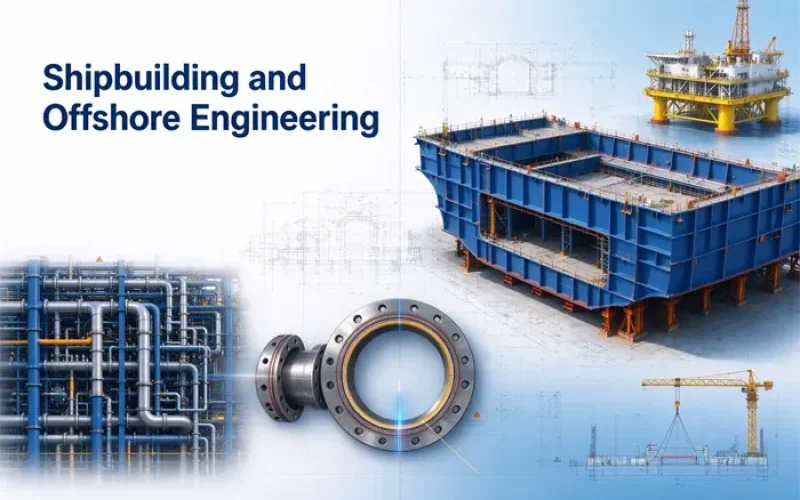
Shipbuilding and Offshore Engineering
This is one of the most typical application scenarios for automatic pipe-flange welding. Ship hulls are packed with dense piping systems of varying diameters, and manual welding simply can’t keep up with the pace—worse, weld quality depends heavily on the welder’s condition. Automatic welding lines in shipyards mainly handle two jobs: first, fit-up and tack welding of flanges to straight pipe; second, automatic welding of internal and external circumferential seams. To deal with the uneven ovality common in domestic steel pipes, today’s dedicated machines usually come with seam tracking or adaptive compensation to prevent burn-through or lack of fusion caused by fluctuating fit-up gaps. Piping systems in offshore engineering follow the same logic, but with even stricter sealing requirements.
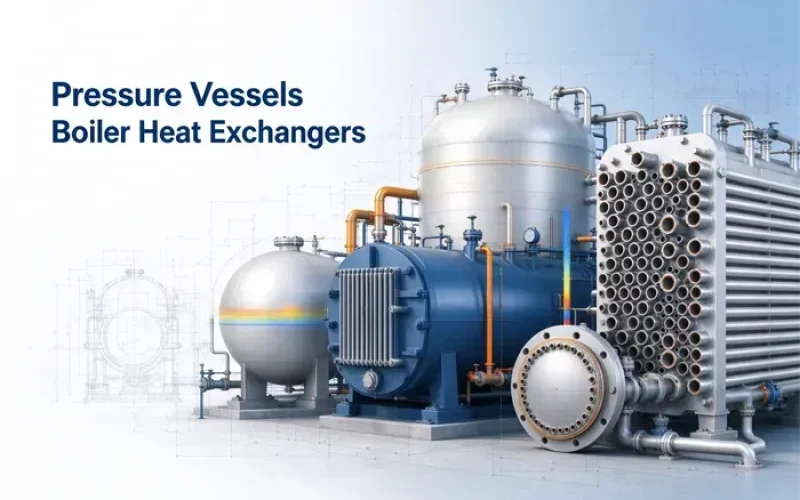
Pressure Vessels Boiler Heat Exchangers
Boilers, heat exchangers, and pressure vessels contain a large number of pipe-to-flange connections. These applications demand extremely strict weld penetration and tightness—any leak can have serious consequences. The advantage of dedicated automatic circumferential welding machines here is parameter repeatability: spindle speed, wire feed, and current for every seam follow preset programs, unaffected by operator mood or fatigue. Suitable for circumferential welding of carbon steel, stainless steel, and even aluminum, typically with wall thickness of 3mm or above, producing uniform weld beads.
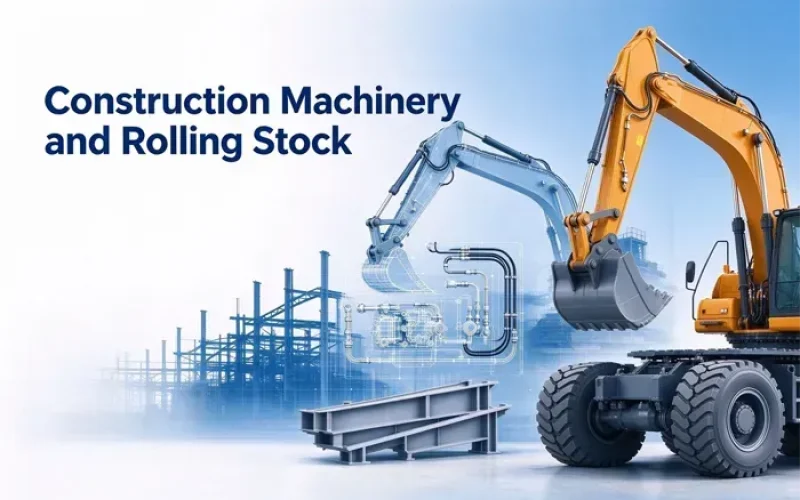
Construction Machinery and Rolling Stock
In construction machinery and rolling stock manufacturing, hydraulic lines and structural tubulars demand consistent, leak-tight welds under demanding schedules. Our automated pipe welding solutions deliver repeatable arc performance, precise heat input control, and stable penetration across varying wall thicknesses and joint configurations. From hydraulic pipe spools to chassis tubulars and fuel lines, our systems combine digital power sources with automated motion control to reduce spatter, minimize distortion, and ensure consistent quality in batch production. Supporting manual, semi-automatic, and fully automated scenarios, our equipment helps manufacturers improve first-pass yield and shorten cycle times while meeting stringent structural and pressure-integrity requirements. Reliable automated pipe welding for mobile machinery and railapplications—contact us to discuss your needs.
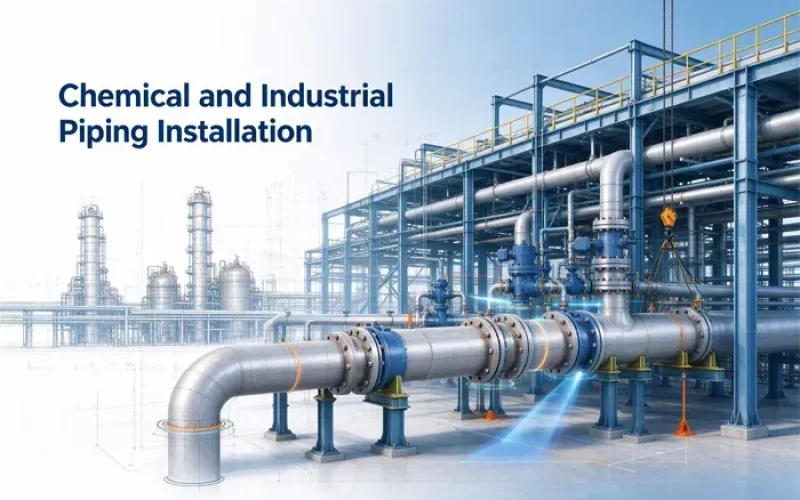
Chemical and Industrial Piping Installation
Process piping in chemical plants—especially clean piping or high-pressure lines—has a huge number of flange connection points. During on-site installation, relying entirely on manual welding makes it hard to control both the schedule and the radiographic inspection pass rate. Some pipe-flange welding machines are designed to be relatively compact specifically to suit workshop prefabrication or on-site installation conditions. That said, on-site pipe-flange automatic welding places higher demands on equipment adaptability and portability than fixed workshop machines—when selecting equipment, you need to distinguish between “production-line type” and “on-site type.”
Frequently Asked Questions
I'm not sure which machine type fits my product — can you help me choose?
Yes. Tell us your workpiece type, such as pipe material, pipe OD range, wall thickness range, length range, weight, monthly or yearly output, welding quality request, —or even product photos or videos. Based on this information, our team will suggest a suitable machine model and configuration. If you can ship product samples to our factory, we will run a free test on the actual machine and send you a video of the results.
Do you offer customized machine solutions?
Yes. In addition to standard machine models, We can customize machines to meet your needs. Whether you need a single machine or an automated production line, we can develop a solution according to your product characteristics, production speed targets, and automation requirements.
What materials can it weld? Carbon steel, stainless, aluminum?
Carbon steel, stainless steel and alloy steel are no problem. Aluminum is more demanding on heat input and wire feed stability—it requires a pulsed MIG or a dedicated aluminum welding power source; TIG aluminum is also possible but slower. Tell us the material and wall thickness first, and we’ll recommend the matching power source and process.
Do you provide installation support, or do we self-install?
We offer overseas engineer on-site service. Meanwhile, our engineers can also guide you with installation via one-on-one online video instruction.
What’s your payment way?
T/T by our bank account directly.
Is after-sales service available?
Yes, we offer both online service and onsite service for technical support and maintenance.
What is the warranty period?
We provide a 1-year warranty starting after the onsite installation is completed.
Get Instant Quote
Lorem ipsum dolor sit amet, consectetur adipiscing elit. Ut elit tellus, luctus nec ullamcorper mattis, pulvinar dapibus leo.
- List Item #1
- List Item #1
- List Item #1